
For years, Indian technology companies have relied on global platforms for core infrastructure. Cloud providers, payment gateways, mapping services, and AI models have largely been built outside India and adapted for Indian businesses.
That narrative is beginning to change.
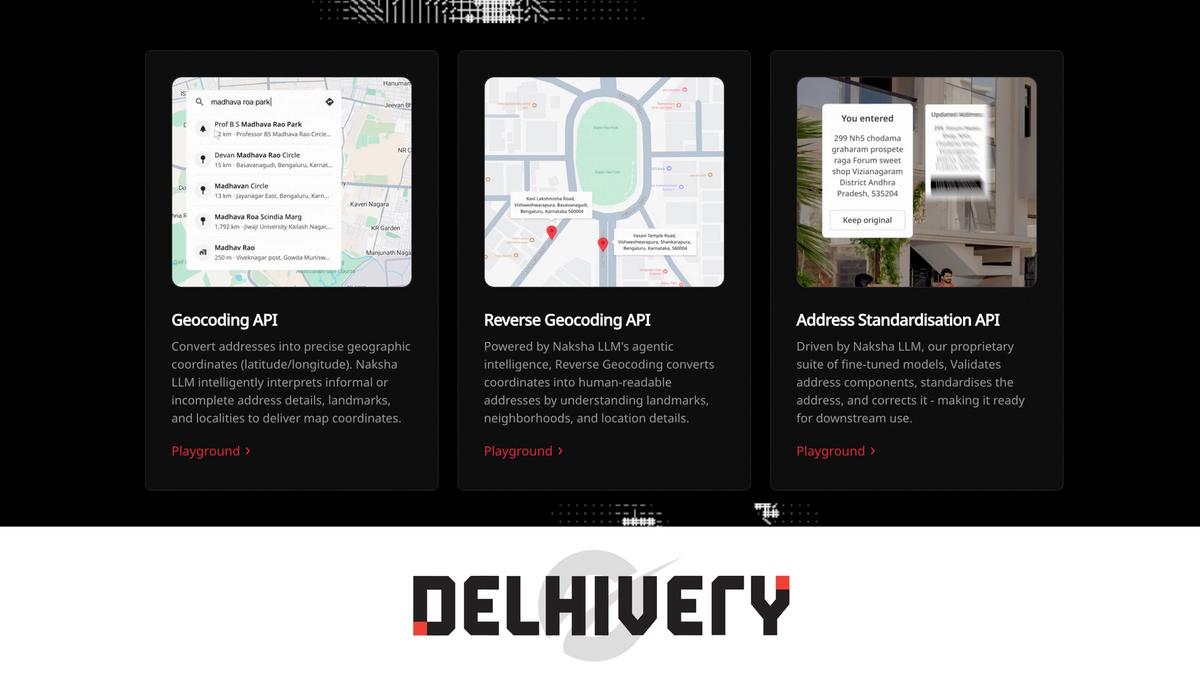
Delhivery's launch of Delhivery Maps, an AI-native mapping and geospatial platform designed specifically for India's address ecosystem, is more than a new product announcement. It represents a shift in how Indian enterprises are thinking about technology.
Instead of adapting global infrastructure to Indian problems, companies are beginning to build infrastructure that starts with India's realities.
And that changes everything.
The Challenge with Mapping India
India is one of the most complex countries in the world when it comes to addresses.
Unlike many Western countries, where addresses follow standardized formats, Indian locations are often identified through landmarks, local businesses, neighbourhood names, evolving road systems, and regional language variations.
An address might read:
"Near Hanuman Mandir, opposite Metro Pillar 52, Sector 18."
To a person, this makes perfect sense.
To a conventional mapping platform, it often doesn't.
This has long been one of the biggest operational challenges for logistics companies, e-commerce businesses, food delivery platforms, field service organizations, financial institutions, and healthcare providers.
Millions of delivery agents solve this problem every day—not because maps are perfect, but because years of operational experience have filled the gaps.
Delhivery has spent over a decade collecting exactly this kind of operational intelligence.
Now, that intelligence is becoming a platform.
From Internal Capability to Enterprise Infrastructure
One of the most interesting trends in enterprise AI is that companies are turning internal operational systems into external products.
The datasets that once existed purely to improve internal efficiency are now becoming commercial platforms.
Delhivery Maps follows this pattern.
Years of deliveries, route optimization, address validation, geospatial intelligence, and logistics operations have created something that generic mapping providers cannot easily replicate.
That's because this isn't simply map data.
It's operational knowledge.
The difference matters.
AI systems become exponentially more valuable when they're trained on domain-specific, real-world data rather than generic public information.
Why This Matters Beyond Logistics
At first glance, Delhivery Maps appears to be a logistics product.
In reality, its impact extends much further.
Accurate geospatial intelligence powers:
- Banking and financial services
- Insurance inspections
- Healthcare outreach
- Field sales operations
- Telecom deployments
- Last-mile commerce
- Emergency response
- Manufacturing supply chains
- Smart city initiatives
Every organization that sends people, products, or services into the physical world depends on accurate location intelligence.
An AI-native platform built specifically for India's geography has the potential to improve efficiency across every one of these industries.
India's Competitive Advantage Isn't Bigger Models
Much of the global AI conversation revolves around larger foundation models.
But enterprises don't gain competitive advantage simply by using the same models as everyone else.
Competitive advantage comes from proprietary data.
It comes from operational expertise. It comes from workflows refined over years.
That's where Indian enterprises have a unique opportunity.
Companies across manufacturing, healthcare, retail, financial services, logistics, and industrial operations have accumulated years of business-specific data that cannot be copied.
This data is becoming the foundation for enterprise AI products.
The organizations that recognize this early won't just automate processes. They'll build entirely new revenue streams.
The Rise of Domain-Specific AI
We're entering an era where the most valuable AI products won't necessarily come from the companies with the biggest language models.
They'll come from organizations with the deepest understanding of their industries.
Imagine:
- Manufacturing companies building predictive production intelligence.
- Banks creating AI-native financial infrastructure.
- Healthcare providers developing diagnostic intelligence.
- Retail businesses building customer behavior platforms.
- Supply chain organizations exposing optimization APIs.
The common thread isn't AI itself. It's years of accumulated operational knowledge. AI simply makes that knowledge accessible at scale.
What Enterprises Should Learn from This
Delhivery Maps offers an important lesson for enterprise leaders.
Many organizations already possess valuable AI assets without realizing it.
- Customer interactions.
- Operational workflows.
- Historical business decisions.
- Support conversations.
- Maintenance records.
- Supply chain events.
- Production data.
Most companies view these as operational records.
Forward-thinking organizations are beginning to see them as intellectual property.
The question is no longer "How do we use AI?"
The better question is: "What proprietary knowledge do we already own that AI can transform into competitive advantage?"
The Future Belongs to Builders
India has spent years proving it can build world-class software services.
The next chapter is different. It's about building world-class platforms.
Delhivery Maps is an example of a broader movement where Indian companies are creating infrastructure designed for Indian realities—and eventually, for global markets facing similar challenges.
At Optivus Technologies, we believe this is where enterprise AI delivers its greatest value. Not with generic implementations. Not through one-size-fits-all automation. But by transforming proprietary business knowledge into intelligent products, AI-powered platforms, and enterprise capabilities that competitors simply cannot replicate.
The companies that succeed over the next decade won't be those that adopt AI the fastest.
They'll be the ones that build AI around what makes their business uniquely valuable.