
For years, payment infrastructure had one primary job: moving money securely, quickly and reliably. That problem has largely been solved. The more interesting challenges now sit around the transaction itself.
A customer abandons a cart. A subscription payment fails. A settlement does not match the bank statement. A payment dispute arrives, or cash flow starts getting tight. In each case, someone on the finance or operations team has to notice the issue, investigate it and decide what to do next.
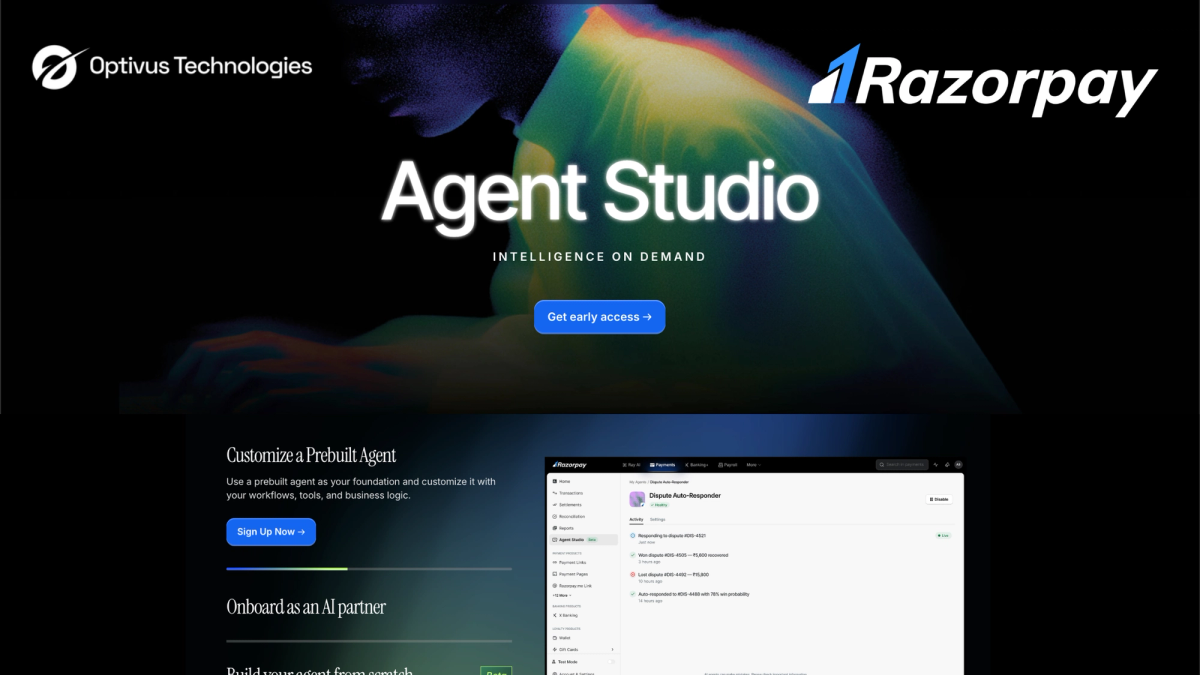
Razorpay's latest move is aimed at this layer. In March 2026, at FTX'26, the company launched Agent Studio, an AI-native platform built using Anthropic's Claude Agent SDK. The platform allows businesses to deploy AI agents for payment and business banking workflows, while also giving them the ability to build their own agents.
The bigger idea is simple:
Don't just automate the payment. Automate the work around the payment.
Payments are already fast. The workflows aren't.
Consider a failed subscription payment. The transaction itself may take only a few seconds, but everything around it can take much longer. Someone needs to identify the failure, decide whether the customer should be contacted, choose the right communication channel and determine whether the payment should be retried. If it fails again, the issue may need further investigation.
For a business with thousands or millions of customers, these small tasks quickly become a significant operational burden. The same applies to disputes, reconciliation, refunds and abandoned carts. While the infrastructure moves money quickly, people are still managing many of the surrounding workflows manually.
That is the gap Razorpay is targeting.
From software that shows to software that acts
Traditional business software is largely built around screens and dashboards. You open a report, filter the data, identify a problem and then take action. AI agents can potentially compress that entire process.
An agent can monitor a situation, understand the context, decide what action is appropriate within its permissions and execute the workflow. That is the basic idea behind Razorpay Agent Studio.
The first production-ready agents focus on four areas:
- Abandoned cart conversion
- Payment dispute response
- Subscription recovery
- Cash-flow forecasting
These are not arbitrary use cases. They sit close to revenue and financial performance. Recovering a failed payment, preventing revenue loss, resolving a dispute and understanding upcoming liquidity needs can all have a direct impact on a business.
Abandoned carts are a good example
Imagine a customer adds a pair of headphones to their cart, reaches checkout and then leaves. The traditional response is predictable: send an email, perhaps follow it with another reminder, offer a discount and hope the customer returns.
Razorpay's Abandoned Cart Conversion Agent is designed to work differently. The agent can access the context of the abandoned session and initiate a conversation through voice or messaging. It can understand why the customer left and potentially offer an incentive before sending a payment link to complete the purchase.
The difference is subtle but important.
The old system says:
"Here is a customer who abandoned their cart."
The agentic system says:
"Here is a customer who abandoned their cart. Let's see if we can recover the sale."
One provides information. The other pursues an outcome.
Context is what makes the agent useful
An AI agent cannot do much if it only knows what is happening inside one application. A failed payment, by itself, does not provide enough information to decide what should happen next.
The customer may have purchased from the business five times before. They may have an open support complaint, a subscription due that day or a preferred communication channel such as WhatsApp. The payment may also have failed because of a temporary issue and be worth retrying.
The more context an agent has, the better its decisions can potentially become. Razorpay says Agent Studio can connect with tools including Shopify, Shiprocket, WhatsApp, ElevenLabs, Slack, Tally and QuickBooks.
This is important because the future of useful agents is unlikely to involve one application doing everything. Instead, agents will need to work across the systems that already contain the information required to make a decision.
Then Razorpay takes it one step further
The platform includes a "Build Your Agent" capability. Businesses can describe what they want an agent to do in plain English, choose the systems it can access and define rules for its behaviour.
That changes the economics of automation. Historically, turning a business process into software required someone to translate the process into technical requirements. This could involve product managers, engineers, APIs, integrations and extensive testing.
An agentic interface can make the first step much simpler. The person closest to the problem can describe it directly.
For example:
"Find customers whose subscription payment failed, prioritise those most likely to recover, contact them through their preferred channel and escalate anything that requires human intervention."
That is a business instruction. The technology underneath can translate it into a workflow.
Of course, the hard part does not disappear. Permissions still need to be defined, workflows need to be tested, exceptions need to be handled and financial actions require strong controls. However, the distance between business intent and software execution becomes much shorter.
Razorpay is changing the interface too
Agent Studio is not the only part of Razorpay's March launch. The company also introduced its Agentic Experience Platform, which brings AI into onboarding, payment management and integrations.
Razorpay says its Agentic Onboarding can reduce onboarding from around 30 to 45 minutes to approximately five minutes. Its Agentic Dashboard allows businesses to interact with payment data through natural language, while Agentic Integration is designed to help merchants and developers integrate Razorpay in under 10 minutes through AI coding environments and no-code tools.
The common thread is intent. Instead of learning how Razorpay's interface works, the business tells Razorpay what it wants to accomplish.
That may sound like a user-experience improvement, but it represents a deeper change in how people interact with software.
APIs gave software instructions. Agents can work with objectives.
APIs transformed software because one system could tell another system exactly what to do: create a payment, issue a refund, fetch a transaction or check a status.
Agents introduce a different model. Instead of specifying every step, a person can describe an objective and allow the agent to work through the necessary actions.
That is particularly interesting in financial operations because many workflows involve decisions rather than simple instructions. A dispute is not simply something to submit. The business may need to understand the transaction, gather evidence, determine the appropriate response and decide whether escalation is necessary.
Similarly, a cash-flow forecast is not just a calculation. It requires looking at historical transactions, upcoming obligations and expected inflows. An agent can potentially bring these pieces together and present a more useful view of the situation.
But financial agents need a higher standard
This is where the agentic future becomes more complicated. If an AI agent recommends a movie and gets it wrong, the consequences are limited. If an AI agent sends money to the wrong account, mishandles a dispute or communicates incorrect information to a customer, the consequences can be much more serious.
Financial agents therefore cannot be evaluated only on how intelligent they appear. They need clear permissions, auditability, predictable boundaries, authentication and escalation paths. Businesses also need to know when a human should take over.
This is likely to become one of the defining challenges of agentic fintech. The smartest agent will not necessarily be the most useful one. The useful agent will be the one that understands what it can do, what it cannot do and when it needs human intervention.
Razorpay's broader direction is worth watching
Agent Studio makes more sense when viewed alongside Razorpay's other moves in agentic commerce.
The company has been working with NPCI and Anthropic to bring agentic payments into Claude, allowing users to discover products and complete payments inside a conversational experience. It has also introduced AI agents into RazorpayX for business banking workflows such as payouts, collections and cash-flow management.
In May 2026, Razorpay launched a payment command-line interface designed for developers and AI builders to manage payments directly from their coding environments.
Taken together, these moves suggest a much bigger ambition. Razorpay is not only trying to make payments easier to integrate. It is trying to make its financial infrastructure something that AI agents can interact with directly.
The real shift is from transaction to outcome
This may be the most important part of the story.
Businesses do not wake up wanting to process payments. They want to sell. They do not want a list of failed transactions; they want the recoverable revenue back. They do not want a reconciliation dashboard; they want their accounts reconciled. They do not want a cash-flow report; they want to know whether they can comfortably meet their obligations next month.
That is the difference between a tool and an agent. A tool gives you the capability to perform an action. An agent can potentially take responsibility for a defined outcome.
Razorpay's Agent Studio is an early attempt to bring that model into payments. Whether every promised workflow can be automated reliably will ultimately be determined by adoption, performance and the quality of the controls around these systems.
But the direction is significant. Payment infrastructure may be entering a phase where it does not just execute financial transactions. It understands the business context around them, watches for problems, takes permitted actions and brings people in when judgement is still required.
That could make the payment gateway look very different five years from now. It may no longer be just a pipe through which money moves, but something much closer to an operating layer for the business.