
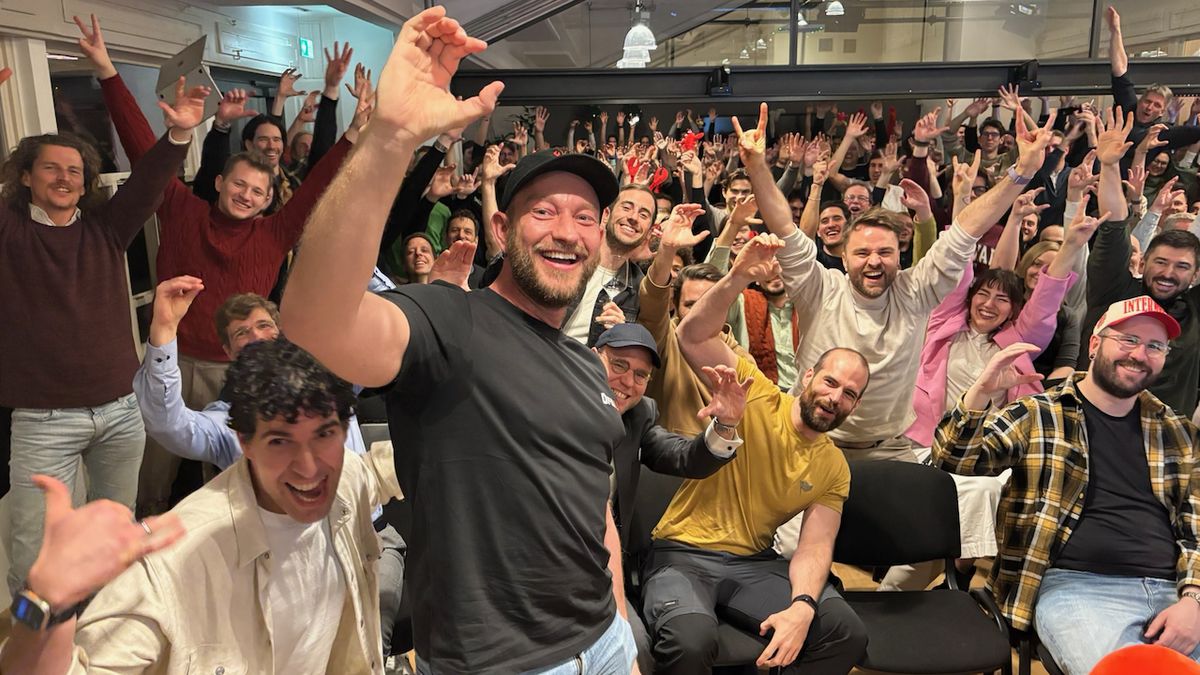
On a quiet evening in November 2025, Austrian developer Peter Steinberger - best known for building PSPDFKit into a document SDK used by Dropbox and IBM before selling it for €100 million - pushed a side project to GitHub. He'd built it in roughly an hour. It was a framework that connected large language models to WhatsApp, letting an AI handle messages autonomously.
He called it Clawdbot.
Four months later, the project - now renamed OpenClaw - hit 250,829 GitHub stars, surpassing React (a library that took over a decade to reach 243,000). Jensen Huang called it "the fastest-growing open-source project in history." Sam Altman hired its creator. And in China, a phenomenon called "lobster fever" saw thousands of people lining up outside Tencent's headquarters just to get help installing it on a Mac Mini.
This isn't a story about a clever bot. It's a story about a tectonic shift in how humans will interact with AI - and what it means for every company building software today.
What OpenClaw Actually Is
Let's be precise, because the hype tends to obscure the mechanics.
OpenClaw is not an AI model. It doesn't compete with GPT, Claude, or Gemini. It's an agentic harness - an open-source framework that sits between any large language model and the messaging platforms people already use every day: WhatsApp, Telegram, Slack, Discord, Signal, iMessage, and Microsoft Teams.
Think of it as the operating system layer for personal AI agents. You bring the brain (any LLM - cloud or local). OpenClaw provides the body: persistent memory, multi-agent routing, tool execution, and a skills ecosystem.
The Architecture in Brief
OpenClaw's design is deceptively simple, which is precisely why it scaled so fast:
- Gateway Layer: A long-living WebSocket server that accepts inputs from any messaging channel. Adapters normalise messages from WhatsApp (via Baileys), Telegram (via grammY), and other platforms into a common format.
- Multi-Agent Routing: Different agents can be configured for different channels, contacts, or even group chats. Your work Slack gets a research agent; your family WhatsApp group gets a scheduling agent.
- Skills via MCP: OpenClaw adopted Anthropic's Model Context Protocol - often described as "USB-C for AI" - as its extension mechanism. Every skill on ClawHub (the community registry, now hosting 3,200+ skills) is an MCP server. This means any tool that speaks MCP works with OpenClaw out of the box, regardless of which LLM is running underneath.
- Local-First Memory: Conversations, agent configurations, and memory are stored as plain Markdown and YAML files on the user's own machine. No cloud dependency. No vendor lock-in.
- Model-Agnostic: Plug in an API key for Claude, GPT-4, Gemini, or DeepSeek. Or run fully local using Ollama. The harness doesn't care.
This architecture means OpenClaw occupies a unique position in the AI stack: it's the layer between the model and the user, and it's completely open.
Why It Exploded
GitHub star counts are a vanity metric - until they aren't. OpenClaw's trajectory (9,000 stars on day one, 60,000 three days later, 190,000 within two weeks) reflects something deeper than developer enthusiasm. It reflects pent-up demand for a very specific thing: AI agents that live where people already communicate.
The Messaging Insight
Every major AI lab has spent the last two years building chat interfaces - dedicated apps or web UIs where users go to interact with AI. OpenClaw flipped this entirely. Instead of making users go to the AI, it brought the AI to where users already are.
This is a profound UX insight. WhatsApp has 2.7 billion monthly active users. Telegram has 900 million. These platforms already handle the hard problems of messaging: push notifications, offline sync, media handling, group dynamics. By building on top of them instead of competing with them, OpenClaw inherited an install base that no startup could replicate.
The MCP Multiplier
Anthropic's Model Context Protocol was released as an open standard in late 2024, but adoption was initially slow. OpenClaw changed that overnight. By making every skill an MCP server, OpenClaw turned MCP from a specification into an ecosystem.
The result was a rapid flywheel: more users attracted more skill developers, which attracted more users. Within weeks, ClawHub had skills for everything from calendar management to code deployment to controlling Unitree G1 humanoid robots via chat.
The "One-Person Company" Promise
Perhaps the most powerful narrative driving OpenClaw's adoption - particularly in China - is the idea that a single person, armed with the right AI agents, can operate what previously required a team.
Schedule meetings. Draft contracts. Monitor servers. Manage social media. Respond to customers. All through WhatsApp messages to an AI that has persistent context about your business.
This isn't theoretical. Chinese local governments in Shenzhen and Wuxi began offering grants of up to 10 million yuan ($1.4 million) specifically to support "one-person companies" built on OpenClaw infrastructure. The Shenzhen Longgang District alone saw over 1,000 applications in the first week.
The Name Drama (And What It Reveals)
OpenClaw's naming history is a microcosm of how fast the AI landscape moves - and how high the stakes have become.
The project launched as Clawdbot in November 2025. In January 2026, Anthropic sent a trademark complaint: "Clawd" was phonetically too close to "Claude." Steinberger complied, renaming it Moltbot on January 27.
Three days later, he renamed it again to OpenClaw, explaining that "Moltbot never quite rolled off the tongue." But during the roughly ten seconds between releasing the old @clawdbot handle on X and securing the new one, scammers hijacked the account (which had 60,000+ followers) and promoted a fake "$CLAWD" crypto token that briefly hit a $16 million market cap.
The incident was absurd, but it underlined a real problem: when an open-source project grows this fast, the attack surface isn't just technical - it's social, financial, and reputational.
China's "Lobster Fever": When AI Goes Mainstream
No account of OpenClaw is complete without understanding what happened in China, because it may be the first time an AI developer tool crossed into genuine mainstream consumer culture.
The Chinese internet dubbed the phenomenon "yang longxia" - "raise a lobster" - a reference to OpenClaw's lobster logo. It became a viral meme, a cultural moment, and an economic wave all at once.
The numbers are striking:
- Nearly 1,000 people lined up outside Tencent's Shenzhen headquarters for OpenClaw installation help
- Mac Mini M4 units sold out across Asian retailers as the recommended hardware for running local agents
- Engineers began charging 500 yuan ($72) for on-site OpenClaw installation, creating an instant cottage industry
- Every major Chinese tech company launched their own version: Tencent (QClaw), Alibaba Cloud services, ByteDance (ArkClaw), Baidu (DuClaw), MiniMax (MaxClaw), and Zhipu AI
- Tencent's stock rose 8.9%; MiniMax briefly surpassed Baidu's market valuation with a 27.4% surge
What made China different from the Western developer community wasn't just scale - it was the profile of adopters. This wasn't limited to engineers. Small business owners, freelancers, content creators, and students all wanted their own AI agent running on WhatsApp (or WeChat, via Tencent's QClaw). The tool had crossed the chasm from developer utility to consumer product.
For anyone tracking AI adoption curves, this is the signal that matters. Not another benchmark, not another model release - but a million non-technical people deciding that an AI agent running on their phone is something they need.
The Security Problem Nobody Can Ignore
Growth at OpenClaw's velocity comes with a cost, and that cost is security.
By late January 2026, security researchers at Censys tracked over 42,665 publicly exposed OpenClaw instances - with 93.4% lacking any form of authentication. The framework's default configuration exposes a WebSocket server that accepts connections from any origin.
The vulnerability list is sobering:
- CVE-2026-25253 (CVSS 8.8): A one-click remote code execution vulnerability via WebSocket origin header bypass, patched on January 30 - but not before thousands of instances were exposed.
- ClawHavoc Campaign: Security firm analysis found that roughly 20% of skills on ClawHub (approximately 900 skills) were malicious - designed to exfiltrate data, steal API keys, or inject prompts that override user instructions.
- Direct Prompt Injection: Researchers demonstrated that link previews in Telegram and Discord could inject prompts into OpenClaw agents, causing them to execute arbitrary actions.
- API Key Leakage: Because users paste their LLM API keys into configuration files, prompt injection attacks could (and did) steal those keys and rack up thousands of dollars in API charges.
The response from major organisations was swift. Meta banned OpenClaw outright from internal use. Cisco Talos published a scathing assessment calling it "an absolute nightmare" from a security perspective. Microsoft published a detailed guide on running OpenClaw safely, essentially acknowledging that many enterprises would adopt it regardless.
This isn't an argument against OpenClaw - it's an argument for treating AI agents with the same security rigour we apply to any other networked software. The framework is powerful precisely because it can execute actions autonomously. That same power, without proper guardrails, is a liability.
The good news: the ecosystem is responding. NVIDIA's NemoClaw (announced yesterday at GTC 2026) directly addresses enterprise security with multi-layer sandboxing, policy-based guardrails, and isolated execution environments - a topic we'll cover in depth in a dedicated article later this week.
What OpenClaw Signals About the Future
Strip away the hype, the star counts, and the lobster memes, and OpenClaw reveals several structural shifts that will reshape the AI industry:
1. The Harness Matters as Much as the Model
For the last three years, the AI industry has been locked in a model race - who has the best LLM, the highest benchmark scores, the largest context window. OpenClaw proves that the orchestration layer is equally important.
Users don't interact with models directly. They interact through interfaces, tools, and workflows. The company that controls the harness - the layer between the model and the user - controls the experience, the data, and ultimately the value chain.
This is why OpenAI hired Steinberger. It's why NVIDIA built NemoClaw. And it's why every major AI lab is now scrambling to develop or partner with agent frameworks.
2. Messaging Is the Universal AI Interface
The app paradigm is under pressure. OpenClaw's success demonstrates that for many tasks, a natural language message to an AI agent is a better interface than a purpose-built application.
This doesn't mean apps disappear. But it suggests a future where the primary way most people interact with AI is through their existing messaging apps - not through dedicated AI chat interfaces, and certainly not through dashboards or command lines.
For businesses, the implication is significant: your customers, employees, and partners may soon expect to interact with your services through AI agents embedded in WhatsApp or Slack, not through your website or mobile app.
3. The "One-Person Company" Changes the Market
If a single person with the right AI agents can do the work that previously required five to ten people, the economic implications are enormous. Not job displacement in the dystopian sense - but a radical expansion of what individuals and small teams can accomplish.
This is already happening in China, where government policy is actively encouraging it. It will happen everywhere else within twelve to eighteen months.
For enterprises, this means the competitive landscape shifts. Your new competitor might not be another company with 500 employees. It might be three people with exceptionally well-configured AI agents.
4. Open Source Wins the Agent Layer
OpenClaw's success, despite its security flaws, demonstrates that the agent orchestration layer will be dominated by open-source frameworks. The reasons are structural:
- Trust: Users are giving these agents access to their messages, contacts, and potentially their financial accounts. Open-source code can be audited; proprietary agent frameworks cannot.
- Customisation: Every business has unique workflows. Open-source frameworks can be extended and modified; closed platforms offer only what the vendor allows.
- Model Independence: Open-source harnesses don't lock users into a single model provider. As models improve and prices drop, users can swap backends without rebuilding their entire agent infrastructure.
The enterprise play (exemplified by NVIDIA's NemoClaw) will be adding security, compliance, and support on top of the open-source foundation - not replacing it.
5. Security Is the Bottleneck, Not Capability
OpenClaw can already do remarkable things. It can manage calendars, draft documents, monitor systems, control robots, and coordinate multi-step workflows across multiple messaging platforms. The technology works.
What doesn't work - yet - is doing all of this safely. The 42,665 exposed instances, the 900 malicious skills, the prompt injection vectors - these aren't edge cases. They're the central challenge of the agentic AI era.
The companies that solve agent security - not just model safety, but the full stack of authentication, authorisation, sandboxing, and policy enforcement - will define the next generation of AI infrastructure.
What This Means for Enterprises
If you're leading technology or AI strategy at an enterprise, OpenClaw's rise demands attention even if you never install it yourself. Here's the practical framework:
Understand the pattern, not just the product. OpenClaw may or may not survive as the dominant agent framework. But the pattern it established - model-agnostic agents, messaging-first interfaces, MCP-based extensibility - is the future. Any agent strategy you build should be compatible with these principles.
Audit your messaging surface area. Your employees are already using WhatsApp, Telegram, and Slack for work. Soon, AI agents will be present in those channels - whether sanctioned or not. Get ahead of this by establishing clear policies and approved tooling.
Invest in agent security now. The gap between agent capability and agent security is the biggest risk in enterprise AI today. Don't wait for a breach to develop sandboxing, authentication, and monitoring for autonomous AI systems.
Watch the "one-person company" trend. If your industry is one where small, agent-augmented teams can compete with large organisations, your moat may be thinner than you think. The defensive play is to adopt these same tools faster and more effectively than your competitors.
Prepare for MCP as a standard. Anthropic's Model Context Protocol is rapidly becoming the lingua franca for AI tool integration. If you're building internal tools or APIs, making them MCP-compatible future-proofs them for the agentic era.
The Bigger Picture
OpenClaw's journey from a one-hour side project to the most-starred repository on GitHub is, at one level, just another open-source success story. But at another level, it marks a turning point in the AI industry.
For the first time, we have a widely adopted, model-agnostic framework that turns any LLM into an autonomous agent capable of operating in the real world - sending messages, managing tasks, controlling devices, and making decisions on behalf of users. The infrastructure for the agentic era isn't coming. It's here.
The questions that remain are not about capability. They're about governance: Who controls the agent? Who is liable for its actions? How do we ensure security without stifling innovation? And how do enterprises adopt these tools without creating unmanageable risk?
These are the questions that will define the next chapter of AI. OpenClaw didn't answer them. But by reaching 250,000 developers in record time, it made them impossible to ignore.
At Optivus, we build agentic AI systems for enterprises - from intelligent automation platforms to autonomous recruitment agents. If you're exploring how AI agents can transform your operations, let's talk.