The challenge
For a staffing company, speed is the business. Every open role brings hundreds of resumes, and the firm that puts a strong shortlist in front of the client first usually wins the placement.
Manual screening made that hard. Recruiters spent hours reading resumes for each opening. Different recruiters judged the same candidate differently. Keyword filters missed strong candidates who described their experience in different words. And chasing candidates for basics like notice period and salary expectations added days to every search.
The result was slower shortlists, uneven quality from one recruiter to the next, and good candidates lost to firms that moved faster.
What we built
We built Janus, a custom AI recruitment platform that covers the workflow from sourcing to screening to hiring in one place.
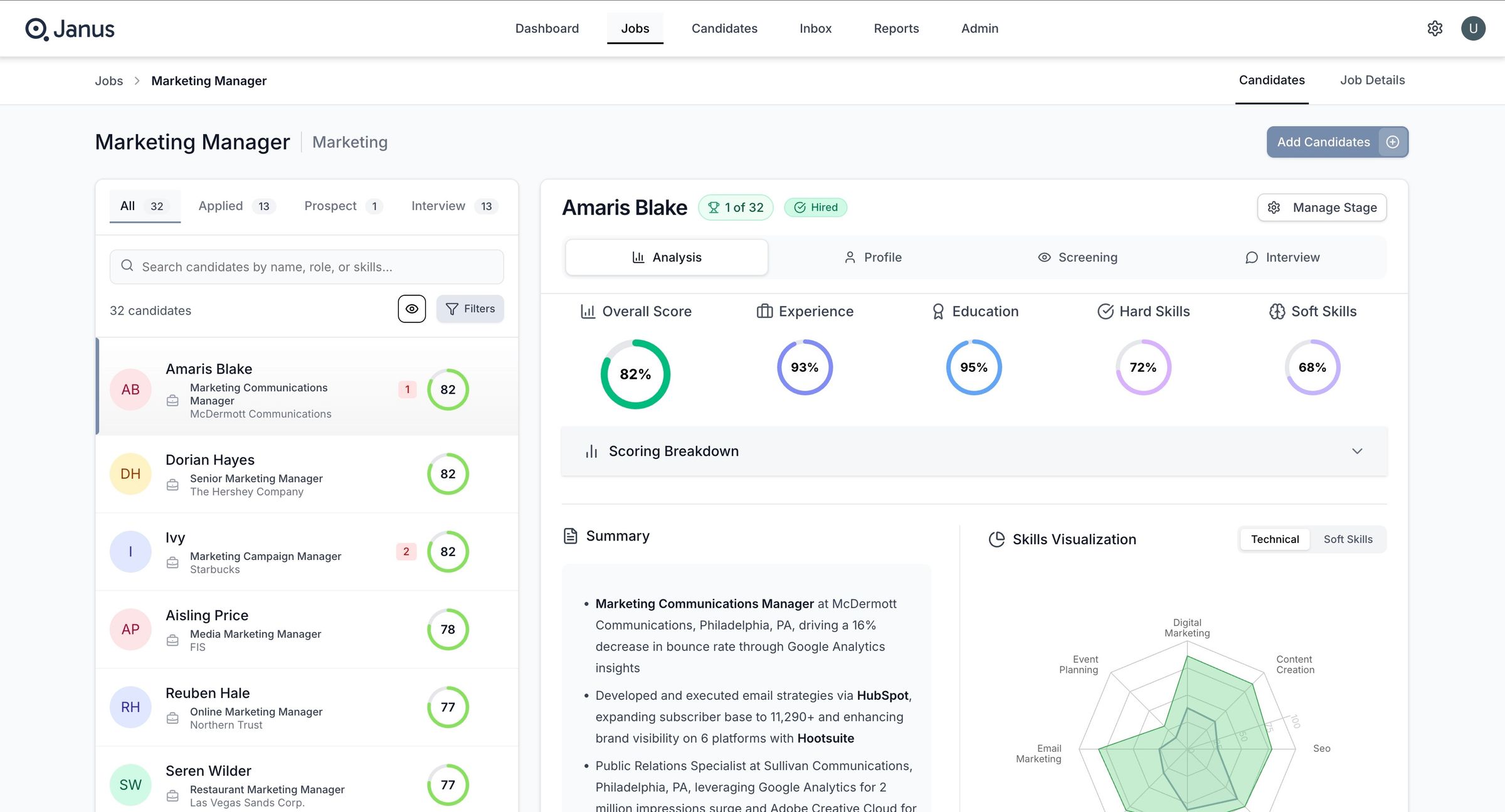
Resume screening against each job description. Janus evaluates every candidate against the specific requirements of the role, looking at skills, experience, education and fit. It understands context rather than matching keywords, so it finds strong candidates that keyword filters miss. It reads every resume in full, so screening thousands of applications takes minutes rather than days.
Explainable scores. Every candidate gets a detailed score breakdown, with evidence pulled directly from their resume. Recruiters can see exactly why a candidate scored the way they did, which makes shortlists consistent and easy to defend to clients. Each score breaks down into experience, education, hard skills and soft skills, so a recruiter can see at a glance where a candidate is strong and where they fall short.
Candidate sourcing. Recruiters can search a database of more than 800 million candidate profiles by skills, experience and location, with AI-written candidate summaries. That lets the team build pipelines proactively and reach passive candidates instead of waiting for applications. Contact details unlock in one click, so a promising profile becomes a conversation straight away.
Screening on WhatsApp. Janus runs automated screening conversations on WhatsApp, asking about notice period, current and expected salary, and role-specific experience. Candidates answer on their own schedule, on a channel they already use, and the AI checks their answers against the role's requirements in real time. Recruiters can then focus their calls on the candidates who fit the brief.
AI interviews. Beyond screening, Janus conducts interviews with candidates using AI. The interview sits in the candidate's record alongside their score, the evidence behind it and their screening answers, so a recruiter has the full picture before deciding who goes forward.
Hiring analytics. Dashboards track the hiring pipeline from application to hire, time to hire, recruiter performance and diversity metrics, with reports exported in seconds. The team can see where candidates stall and fix the bottleneck.
Integrations. Janus connects with the tools recruiters already use, including Zoho, SAP, Gmail, Google Calendar and Microsoft Teams, so candidate data flows without re-keying. It also syncs with HubSpot, Slack, Notion and Google Drive, and has WhatsApp and email built in.
How a candidate moves through Janus
- Sourced or applied. Candidates come in through applications, or recruiters find them in the sourcing database.
- Scored against the role. Janus scores each resume against the job description and shows the evidence behind every score.
- Screened on WhatsApp. Promising candidates answer the screening questions on WhatsApp, and Janus checks their answers against the role.
- Interviewed. The best fits move to interview, including AI interviews run on the platform, with the score, the evidence and the screening answers in one place.
What recruiters gained
Before Janus, a shortlist was the product of hours of reading and one recruiter's judgement. With Janus, every candidate arrives with a score, the evidence behind it and their answers to the screening questions.
Recruiters spend their time on the strongest candidates and on conversations with clients, not on reading resumes and chasing basic details.
Results
Recruiters screened more than 10,000 resumes through Janus, and the platform conducted more than 200 AI interviews.
Janus gave the client's recruiters one place to source, screen and qualify candidates, with consistent, explainable scoring on every application and screening questions answered on WhatsApp before a recruiter picks up the phone.
Because every score comes with its evidence, each shortlist the team sends a client can be explained candidate by candidate.
Why it worked
- Built for volume. Janus was designed for a staffing business that screens at scale, without sacrificing depth on each candidate. It reads every resume in full, however many arrive.
- No black boxes. Explainable scores gave recruiters confidence in the AI and gave them evidence to share with clients. Recruiters can review any score, challenge it and make the final call.
- Meeting candidates where they are. WhatsApp screening made it easy for candidates to respond quickly, on their own schedule instead of waiting for a call.
- Fits the existing stack. Integrations meant recruiters didn't have to change how they work. Candidate data flows into the systems the firm already runs.